
In May, I went to Washington D.C. (Where I proposed to my beautiful fiancée.) While there, I paid a visit to the Thomas Jefferson Memorial. Engraved on its southwest wall is an excerpt from the Declaration of Independence. I read it and felt the hair on my arm begin to rise. “How could someone write so beautifully, so prophetically?” I thought to myself as I looked up at the marble-carved passage. And Jefferson wrote it without the internet, a word processor, or artificial intelligence!
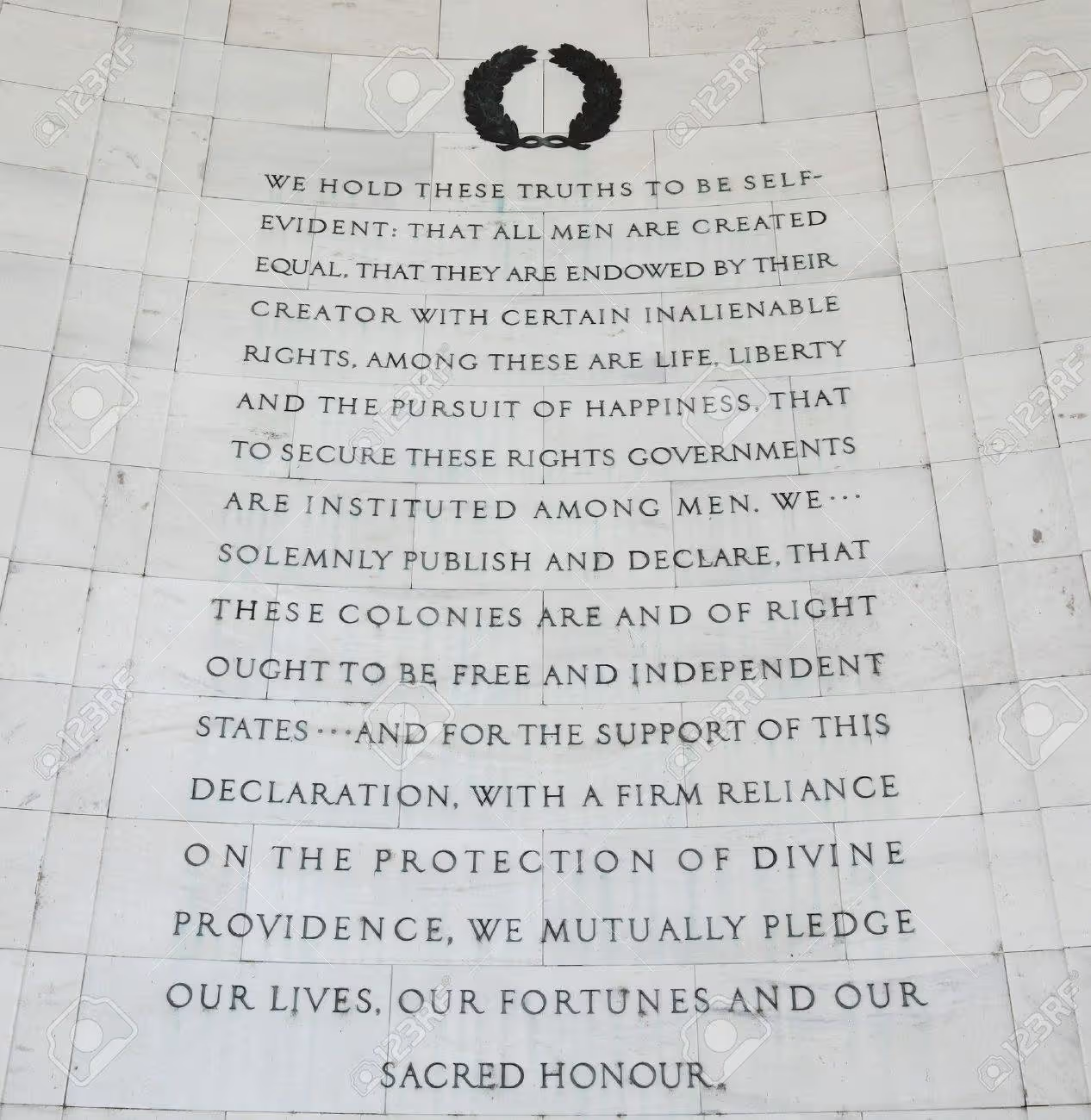
It was not my first time reading that passage. But something about that visit, probably the grandeur, caused me to reflect. Do I see that level of writing from myself? Absolutely not. Do I see that level of writing from my peers or my community? Also no. I think the latter is more telling.
As a district prosecutor in rural Kentucky, I do not expect masterpieces. And as a district prosecutor who runs a rural Kentucky county’s juvenile docket, I do not expect much. But there can be no valid excuse for the writings that cross my desk. Juveniles, who often write letters of apology or research papers as part of their sentence, barely have a grasp on comprehension, let alone expression. Run-on sentences, improper syntax, and grammatical errors are the norm. Unfortunately, my school partners say this is not limited to troubled youth.
The data backs this up. U.S. test scores are in a “Generation-Long Decline.” Rich and Poor; Black and White. Math is down; Reading is worse. The problems arose in the mid-2010s, when No Child Left Behind began to ease and smartphones, social media, and personalized school laptops began to rise. The experts say there is no single reason; and BigTech is aiming to keep it that way, fighting hard against litigation from local school districts.
I think we’re looking at it wrong. The problem child here is standardization. And standardization, although introduced in 1994 with Clinton’s Improving America’s Schools Act, did not gain teeth until Bush’s No Child Left Behind Act. Clinton saw poor compliance–less than half of states met standards. Bush saw absolute adherence–every state plus the District of Columbia complied. In 2015, Obama split the baby with the Every Student Succeeds Act–keeping Clinton’s standardization but removing Bush’s consequences for poor performance. It is no coincidence that test scores fell: by the time everyone was on the same page, Congress stopped caring whether schools were even teaching from the same book.
This is not to say the No Child Left Behind act was good. Nor that multiple choice tests, Common Core, or “high academic standards” are bad. But why are far-away pundits making the standards to educate our children? Am I crazy to think a boy from the Bronx may learn differently than a girl from the sticks? Or an educator from the south may teach differently than an instructor in the north?
Now, I can already hear some of you saying, “Gavin, these are just standards. Nothing in these Acts restricts what/how states teach.” And that’s true. But federally mandating assessments indirectly narrows the curriculum and pedagogy. In other words, conditioning federal funds on compliance with federal standards necessarily changes what and how states teach–colloquially known as “teaching to the test.”
Dr. Richard Phelps, a member of the Nonpartisan Education Group, believes this to be a Red Herring. He equates teaching to the test to “dogma”; a ploy used by educational “obfuscators” to ignore the real problem–“educators cheat[ing] on tests administered internally with lax security.” In his opinion, the “obvious solution” is taking test administration out of educators’ hands. Instead, educators–and educational lobbyists–demonized “high-stakes tests” and the frequency with which they are administered (i.e., too big, too often).
But two things can be true at once. Educator misfeasance is real; but it is driven in large part because of the overwhelming pressure teachers feel to comply with standardized, high-stakes tests. The data, once again, tracks: teachers report feeling a large amount of pressure for students to perform well on standardized tests. And they don’t believe it’s working. Eighty-two percent of public school teachers say K-12 education has worsened in the past five years, and only twenty percent expect improvements. The end result? A significant portion of educators report feeling overwhelmed, and a majority would not advise a young person to become a teacher.
If you don’t think that sentiment translates to the classroom, you may be the very students I’m referring to. Kids are impressionable, and they pick up on an instructor’s emotional state. If the majority of teachers have a negative view of the educational field, how do you think the kids feel? No wonder truancy rates and behavior problems are high!
Which leads me to my point: We need to bring back passion. Jefferson wrote beautifully because he believed in what he said. He bought in. Can our students–or the people who teach them–say the same? If not, why?
I think it’s because there’s no identity. When the end goal of education is a neat, delineated list of punch-card objectives, the classroom becomes a factory. We need to reinstill education as a means, not an end. (And maybe that is something I should take personally, considering I use writing as a sentence.)
Standardization didn’t kill passion by being too strict. It killed it by being unfalsifiable. Yes, as the legislation currently sits, states technically control what and how they teach. But if you believe it’s purely that, then I implore you to ask any mid-2010s graduate, “What is the powerhouse of the cell?”
Jefferson may not be the best example. He was elite, beginning his classical education at nine and continuing well within his adulthood. But passion is not bound by money or fame. After all, Charles Dickens worked in a boot-blackening factory, and Alexander Hamilton was an orphan. No, passion is built off stakes. You need some skin in the game. That can be top-down, i.e., the federal government punishing noncompliance, or bottom-up, i.e., local communities holding one another accountable. Because I prefer the latter, I’m starting with myself. If I want America to do well (and I do), then I need to practice what I preach. I need to produce passionate work. It’s why I started this letter.
Will I get things wrong? Absolutely. Will I make a fool of myself? Probably. But you can’t say I didn’t try. And, more importantly, I’m trying my way–not the way everyone else thinks you should. We need to set standards by rejecting the standards. America, where’s the passion?